
 SR
 EN
Perspectives in Expert Consilium
A perspective is a predefined role from which the same business decision is examined. This page describes which roles exist and how we work.
What a perspective is.
Each perspective is a separate call to an AI model, with its own instructions and a few short, hand-written principles for that role. Perspectives are not separately trained models.
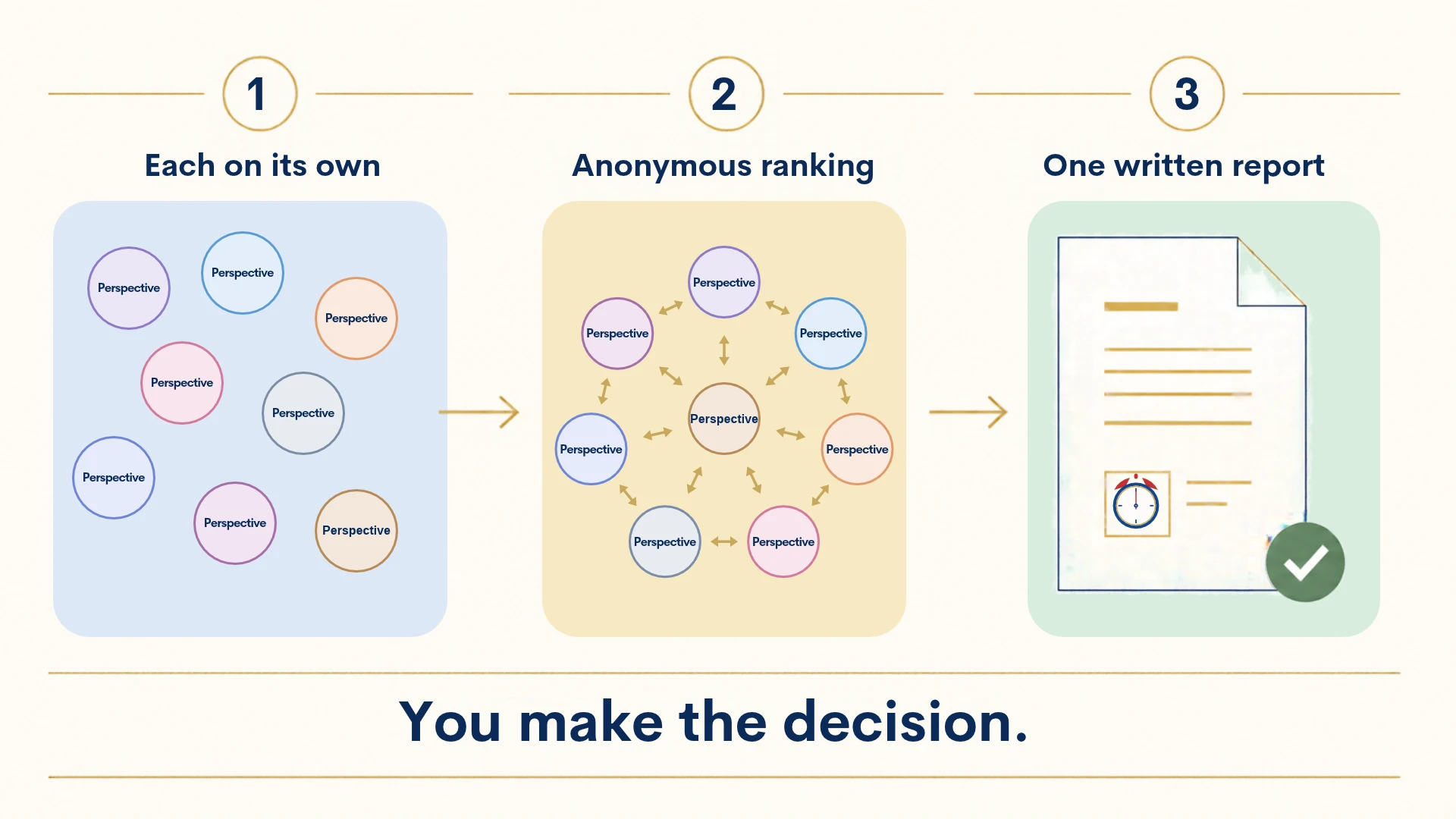
In the first stage each perspective examines the same question on its own, without seeing the others' answers. They then anonymously evaluate and rank each other, and everything is brought together in one written report. You make the decision.
Roles by level.
Essential
4 perspectives
- Operational feasibility. The first concrete step that can be taken right away, with as little theory as possible.
- Challenging assumptions. What could most likely ruin the decision and which assumptions are weak.
- Financial discipline. Figures, cash flow and real profitability, and where the data is incomplete.
- Strategy. What the decision means for the business, who the customer is and what they really value, and whether the goal can be measured with the figures you gave.
Consilium
8 perspectives
- Strategy. What the decision means for the business, who the customer is and what they really value, and whether the goal can be measured with the figures you gave.
- Clarity and fact check. Whether the matter can be explained in plain language, what has been checked and what is only an assumption.
- Cognitive biases. Biases and overconfidence in the question itself or in the obvious answer.
- Direct feasibility assessment. An open assessment of what does not work in practice, without softening, but professionally.
- Message and market. How the decision is presented to a customer or the market, and whether an average customer would understand it from one sentence.
- Speed of execution. The fastest path from first principles, and the cost of a mistake if you move fast.
- Relationship structure and protection of interests. How the relationship with the partner is set up and where risks hide in the wording. Not legal advice.
- End customer. How the decision affects the end customer or user, and whether they would accept it if they knew every detail.
Grand Consilium
12 perspectives
- Strategy. What the decision means for the business, who the customer is and what they really value, and whether the goal can be measured with the figures you gave.
- Clarity and fact check. Whether the matter can be explained in plain language, what has been checked and what is only an assumption.
- Cognitive biases. Biases and overconfidence in the question itself or in the obvious answer.
- Message and market. How the decision is presented to a customer or the market, and whether an average customer would understand it from one sentence.
- Speed of execution. The fastest path from first principles, and the cost of a mistake if you move fast.
- Relationship structure and protection of interests. How the relationship with the partner is set up and where risks hide in the wording. Not legal advice.
- End customer. How the decision affects the end customer or user, and whether they would accept it if they knew every detail.
- Hidden risks. Rare but severe outcomes, and who bears the consequence if the assessment is wrong.
- Negotiating position. What the position in a negotiation is, and which wording can be used in the conversation.
- Synthesis and practical judgement. Brings the others' insights together into clear, workable steps, without too much caution and without too much boldness.
- Regulatory view. Recognises which industry or product is involved and considers the rules that apply to it. Not legal advice.
- Re-examining its own conclusion. Tests its own first conclusion against the opposite argument and states what would change it.
How a perspective knows what to do.
- Each perspective gets written instructions for its role: what it looks at and how it answers.
- The instructions come with a short selection of hand-written principles, chosen according to your question.
- The model is not further trained on books or texts and has no access to outside sources for that role. It relies on the general knowledge it already has and on these two parts.
- Each perspective is a separate call, often a different model, so it does not see the others' answers while writing its first answer.
What we do not claim.
Perspectives are not real people. Expert Consilium is automated decision support, without human review. It is not legal, tax, accounting, investment, medical or other regulated advice and does not promise an outcome.